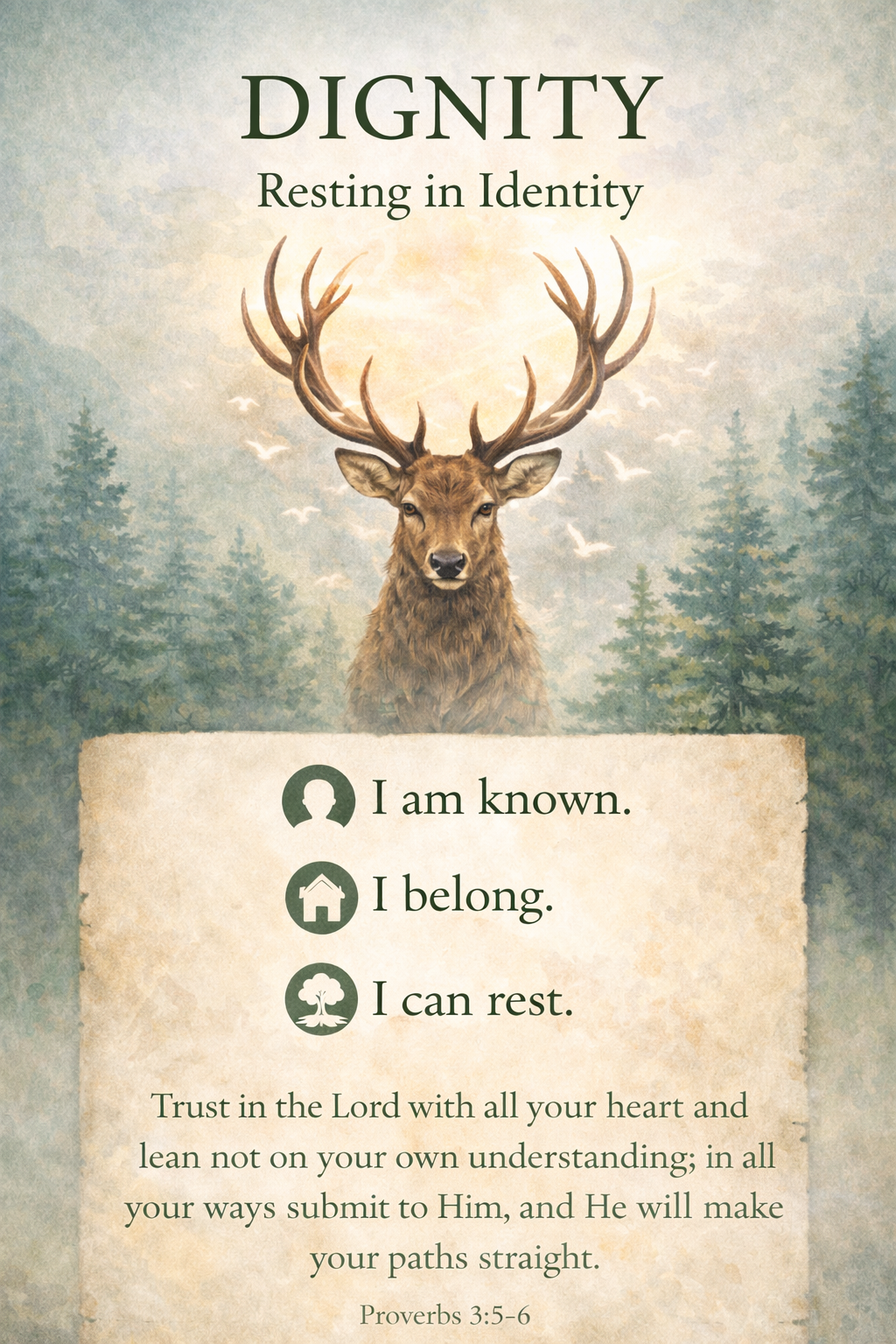
2026 February- Dignity begins with Identity
Month 2 Parent Guide — Resting in Identity
This month is about helping your children experience ease.
Not the kind of ease that avoids effort—but the kind that comes from knowing:
who you are,
where you belong,
and who is carrying what you cannot.
Dignity deepens when children realize they do not have to hold everything together.
As always, this is not about forcing understanding.
It’s about creating space for truth to settle.
You don’t need perfect words.
You don’t need perfect timing.
You just need presence.
God does the forming.
Step 1: Begin with the Body
Before talking, invite your children to notice their bodies.
You might say:
“Let’s all take one deep breath together.”
Then ask:
How does your body feel right now?
Do you feel rushed or calm?
Where do you feel tension?
There are no right answers.
This step is about noticing what ease and unease feel like.
You’re helping them learn that dignity is not just a thought—it’s something we carry.
Step 2: Name the Big Idea
You can say something like:
“This month, we’re learning that dignity grows when we know who we are, where we belong, and that we don’t have to do everything on our own.”
Say it slowly.
Then ask:
Which part of that feels comforting?
Which part feels hard to believe?
Let their answers be incomplete. That’s okay.
Step 3: Connect Identity to the Four Truths
Explain gently:
“At Rooted, we use Four Truths to help us remember what is already true—especially when life feels confusing or heavy. These truths help us rest in who we are.”
Read or recite the Four Truths together:
I am wonderfully and beautifully made for glory AND adversity because it is written in God’s Word.
My family loves me no matter what.
I can try anything because if I fail, I know I can learn.
I am a sinner saved by grace and created in the image of God for good plans that He has already prepared for me.
Then say:
“These truths don’t change based on how we feel or how well we perform. That’s why they help us live with dignity.”
Ask:
Which truth helps you rest the most?
Which truth feels hardest to believe sometimes?
Which truth helps you remember you’re not alone?
Step 4: What It Means to Be “At Ease”
You might say:
“Being at ease doesn’t mean nothing is hard.
It means we know who is holding us when things are hard.”
Then explain:
Being at ease means:
I don’t have to rush to prove myself.
I don’t have to panic when I make mistakes.
I don’t have to carry everything by myself.
Ask:
When do you feel the most pressure to ‘get it right’?
What helps you calm down when you feel overwhelmed?
Step 5: Dependence Is Not Weakness
This is the heart of the month.
You can say:
“Sometimes people think dignity means being strong all by yourself. But in God’s family, dignity actually grows when we learn to depend on Him.”
Then say clearly:
Dependence is not giving up.
Dependence is trusting the right source.
Dependence is knowing where help comes from.
Connect it back to identity:
“Because we know who we are and where we belong, we can lean on God without fear.”
Ask:
What feels hard to ask for help with?
What would it look like to give that to God?
Step 6: What Resting in Dignity Looks Like (For Kids)
Dignity can look like:
Taking a break without guilt
Asking for help when something feels too big
Trying again without shame
Letting God handle what you can’t
Dignity can sound like:
“I don’t have to figure this out alone.”
“I can trust God with this.”
“I’m still loved even when I mess up.”
“This is hard, but I’m not alone.”
Ask:
Which one of these do you want to practice this week?
Which one feels hardest?
Step 7: Anchor in Scripture
Read the verse slowly:
“Trust in the Lord with all your heart and lean not on your own understanding;
in all your ways submit to Him, and He will make your paths straight.”
— Proverbs 3:5–6
Then point out:
God does not ask us to know everything.
He asks us to trust Someone.
You might say:
“When we trust God, we don’t lose dignity—we grow into it.”
Ask:
What does it mean to lean?
What is something you want to lean on God for right now?
Closing Thought for the Month
You might end with this reminder:
“Dignity isn’t about holding it all together.
It’s about knowing who you are, where you belong, and who holds you.”
Or for younger kids:
“I am known. I am loved. I can rest.”